
Key takeaways
- Andres Properties buys houses across St. Vital as-is, for cash, from the 1930s river lots on Kingston Crescent to the 1960s bungalows along St. Mary’s Road.
- Three quarters of the homes in north St. Vital were built before 1981, and nearly half of that area’s households rent, per the 2021 census.
- Red River bank erosion is the owner’s cost here. Five St. Vital families were quoted up to $900,000 in 2020 to rebuild their banks. We buy river lots as they are.
- One in five St. Vital residents is over 65. Estate and downsizing sales are the most common reason people in the older north end call us.
We buy houses in St. Vital, Winnipeg for cash and as-is. If you own a home between the Red and Seine rivers, in Glenwood, Norberry, St. George, Minnetonka, Meadowood, or River Park South, we can make a fair, no-obligation offer on it in its current condition, with no repairs, no cleanout, and no showings.
Old St. Vital and new St. Vital
St. Vital was settled by francophone families in 1822, named by Archbishop Taché in 1860, and grew so fast through the 1950s and 60s that it became its own city in 1962 with 27,000 people. Ten years later it was absorbed into Winnipeg, and residents held a mock burial of the city crest to mark the occasion. The neighbourhood has kept that independent streak, and it has kept two very different halves.
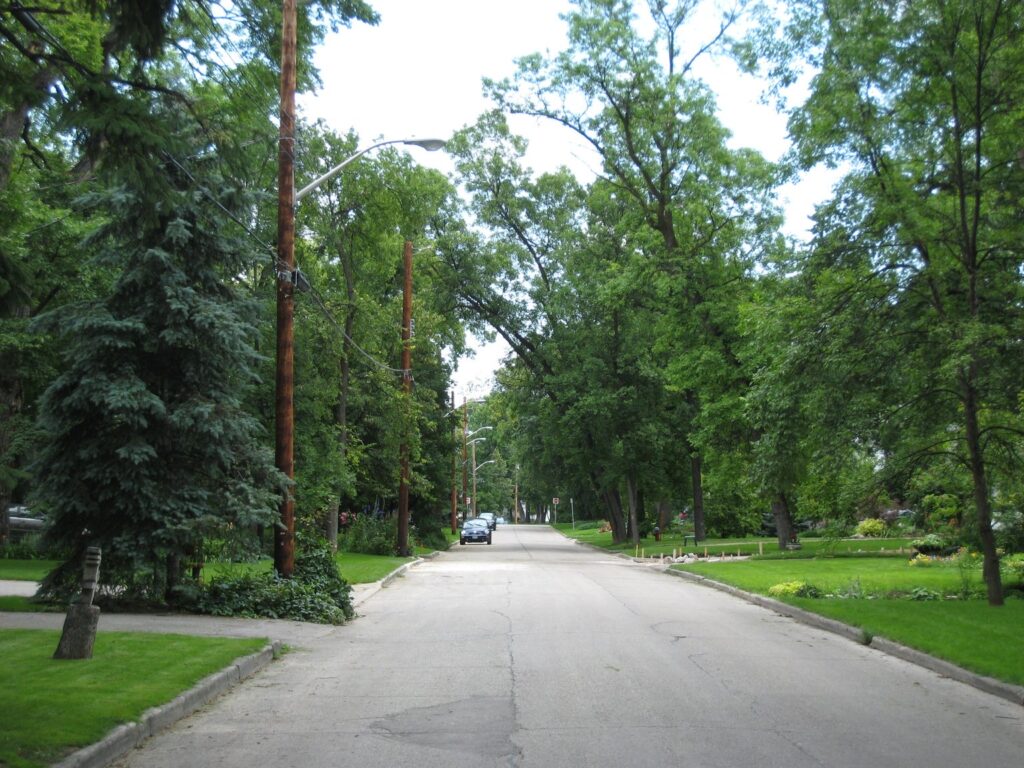
North of Bishop Grandin is the old St. Vital: Glenwood, one of the area’s first neighbourhoods, along the Seine; Kingston Crescent and Elm Park, laid out around an 1890 streetcar park inside a tight bend of the Red, with most of the homes built in the early 1930s; and the 1955 to 1975 bungalows and side-splits of Norberry, St. George, Pulberry, Worthington, Dakota Street, Chrysler Avenue, and Minnetonka Drive. The 2021 census counts 39 percent of north St. Vital’s dwellings as built before 1961 and another 36 percent from 1961 to 1980. Just over 7 percent need major repairs, above the city rate, and 47 percent of households rent.
South of Bishop Grandin is the newer St. Vital: Meadowood, River Park South, Dakota Crossing, Royalwood and Normand Park from the mid-1980s to mid-2000s, and Sage Creek, which broke ground in 2005 and is finishing its final phase. We buy in both halves, but the calls come mostly from the north.
The river is the story in St. Vital
The 1950 flood put the entire developed area of St. Vital under water, and Kingston Crescent and Elm Park were hit hardest. The 1997 flood brought checkpoints and sandbagging back to Kingston Row. Flooding is not the day-to-day problem now; the bank is. In 2020, five homeowners along the Red in St. Vital were told rebuilding their eroding riverbank could cost up to $900,000 before tax. The City has no fund for private riverbank work, and the Province calls erosion the landowner’s responsibility.
A river lot with a slumping bank is nearly impossible to sell with a mortgage, because the buyer’s lender will not lend and the insurer will not cover the bank. We have bought properties like that. Our offer accounts for the bank instead of walking away from it.
What the inspection turns up in a north St. Vital home
| Home type | Typical issues | Rough repair cost if you fixed it first |
|---|---|---|
| 1910s to 1950s river-lot homes (Kingston Crescent, Elm Park, Glenwood) | Stone or early poured foundations, clay-tile sewer lines with root intrusion, older wiring and plumbing | Waterproofing $5,000 to $30,000; underpinning $30,000 and up; sewer replacement in the low five figures |
| 1955 to 1975 bungalows and side-splits (Norberry, St. George, Dakota, Minnetonka) | Cast-iron stacks near end of life, original windows and furnace, moisture in low-lying basements near Minnetonka and Chrysler | Mechanical and window round often $20,000 to $40,000 |
| Any home on Winnipeg clay | Foundation cracks and heaving from the freeze-thaw cycle | Crack injection a few hundred dollars each; structural work far more |
Those ranges come from local foundation and brokerage sources, and they are the reason a listing in old St. Vital so often gets renegotiated after the inspection. We price the work before we make the offer, and the offer is what you receive. No conditions, no lender, no repairs.
Who sells to us in St. Vital
St. Vital has about 69,600 residents and one of the older age profiles in Winnipeg, with 19.5 percent over 65. Two in five families are couples whose children have left home. In the north end, where the houses are oldest and the rental share highest, the situations we see most often are:
- An inherited bungalow off St. Mary’s Road that has been in one name since the 1960s.
- A landlord with a duplex or a converted house who wants out with the tenants still in place.
- A river-lot owner who cannot justify the bank-stabilization estimate and wants a clean exit.
- A couple separating who need one fair number and a certain closing date.
- Anyone whose house has simply reached the point where the repairs cost more than they want to spend.
Where we buy in St. Vital
We buy throughout the R2M and R2N postal areas: Glenwood, Kingston Crescent, Elm Park, Norberry, Pulberry, St. George, Worthington, Varennes, Lavalee, Alpine Place, Victoria Crescent, Minnetonka, Meadowood, Dakota Crossing, River Park South, Normand Park, Royalwood, Vista, and Sage Creek. You know the landmarks: St. Vital Centre, St. Vital Park on the river bend, Riel House on River Road, and the Dakota Community Centre and Jonathan Toews Sportsplex. We buy in St. Boniface across the Seine as well. See every Winnipeg area we serve.
What we pay
Detached homes across Winnipeg averaged about $469,000 through August 2026, according to WinnipegREALTORS, and St. Vital spans a wide range around that, from older north-end bungalows well below it to Sage Creek two-storeys above it. Our offer is not tied to the listing price. It starts from what your house would sell for fully updated, subtracts the cost of the work it needs and our costs to resell, and the rest is yours in cash with no commission or fees. What cash home buyers actually pay walks through the math, and how to sell your house fast in Winnipeg covers the timeline.
Get a cash offer for your St. Vital house
There is no cost to finding out what your house could sell for as-is, and no obligation attached to the number. Tell us about your property and we’ll get back to you with a fair, no-strings cash offer, or call or text Jason directly at 204-371-3559.
Frequently asked questions
Do you buy St. Vital houses on the Red River with eroding banks?
Yes. Riverbank repair along the Red in St. Vital has been quoted at hundreds of thousands of dollars, and the City and Province both say it is the landowner's cost. We buy river lots as they are and account for the bank in our offer.
Will you buy an older bungalow along St. Mary's Road in north St. Vital?
Yes. The 1955 to 1975 bungalows and side-splits of Norberry, St. George, Pulberry, and Dakota Street are the homes we buy most often in St. Vital, including ones with cast-iron stacks, original windows, and damp basements.
Can I sell a St. Vital duplex or rental with tenants in place?
Yes. Nearly half of north St. Vital households rent, and we buy tenant-occupied properties without asking you to end any lease. The tenancy transfers with the property under Manitoba's rules.
Do you buy in Sage Creek, River Park South, and the newer parts of St. Vital?
Yes. We buy across all of St. Vital, from Kingston Crescent and Glenwood in the north to Meadowood, Royalwood, and Sage Creek in the south. Newer homes usually come to us for reasons of timing rather than condition, such as a divorce or a job move.